


The New Axis of Global Power: How Does the U.S. Respond to the Alliance of China, Russia, and India?
September 9, 2025 Hour: 9:15 am
🔗 Comparte este artículo
The new global power axis formed by China, Russia, and India represents a substantial challenge to U.S. hegemony, and the U.S. response reflects political, economic, and technological concerns.
RELATED:
India and Russia Are Moving Closer to China, Trump Acknowledges
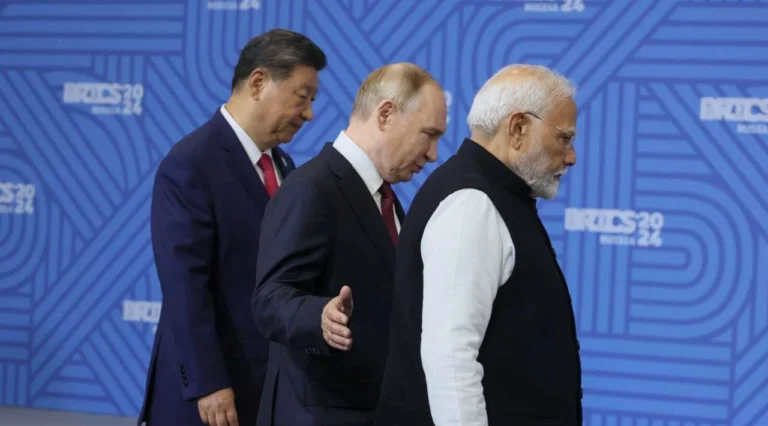
This strategic alliance, solidified at the Shanghai Cooperation Organization (SCO) summit, not only presents a new multipolar configuration of the world but also raises profound questions about the future of the international order, with repercussions for the global economy, technology, and geopolitical relations.
The photograph of Xi Jinping, Vladimir Putin, and Narendra Modi together symbolizes a political will to counteract the supremacy of Washington and its traditional allies.
This union emerges in a context of intensified trade tensions, initiated by the Trump administration, which implemented specific tariffs and sanctions aimed at weakening alliances that challenge U.S. dominance.
Trump, through his “Truth” platform, has openly expressed his concern, labeling this alliance a bloc “against the United States.”
However, his discourse focuses more on military superiority than a direct response to the political or economic consolidation of this new axis.
Divergent Reactions in the United States
Within the U.S., the reaction to this alliance is not uniform. The Republican sector, led at the time by Trump, has shown rejection and alarm, accusing the connections between Russia, India, and China of representing a “deeper and darker” threat.
However, economic sanctions and pressures on India’s purchase of Russian oil have failed to stop it, demonstrating the limitations of U.S. coercive policy.
On the other hand, a more critical interpretation of Trump’s inherited confrontational policies comes from the Democratic Party.
Democrats warn that the policy of tariffs and unilateral threats may be driving a truly multipolar world, one that is fragmented and potentially more unstable, moving away from the traditional U.S.-led Western order.
According to this sector, maintaining that hegemony requires strategic and diplomatic adaptation, not just a rigid military or economic stance.
It is recognized that China is leading a structural change in the world order, with the Asia-Pacific region and the Global South reorganizing against Western predominance.
The analysis suggests the urgency for the United States to understand this phenomenon beyond a binary antagonistic narrative, as the transformation of global rules and alliances is at stake.
Economic Implications of the New Bloc
In economic terms, the union of China, Russia, and India poses direct challenges to the U.S. model. The joint exploration of alternative financial institutions, such as a regional development bank and mechanisms to settle trade in their own currencies, defines a clear strategy to weaken the dollar’s dominance as the world’s reserve currency.
This shift would affect Washington’s ability to impose sanctions and coercive mechanisms in its foreign policies, limiting its global influence.
Furthermore, the restructuring of global trade proposes to bypass traditional institutions controlled by the West, such as the International Monetary Fund, which often extends “conditionalities” of economic reforms that are questioned by many countries in the Global South.
The redefinition of trade rules, incorporating aspects of labor and environmental rights, could challenge the neoliberal model that has prevailed.
The world, therefore, is heading towards a transformation where countries seek greater autonomy and justice in international economic relations.
U.S. tariff policy has incentivized the fragmentation of supply chains, forcing key countries like India to seek new trade routes and partners, weakening previous strategic alliances. T
This trend suggests that unilateral trade confrontation has been counterproductive, making it difficult for the U.S. to maintain its partners.
Technological and Strategic Challenges
In the technological field, the alliance has ambitious goals that could alter Silicon Valley’s leadership and U.S. technological supremacy.
The cooperation among these three countries in artificial intelligence, digitalization, and cybersecurity combines their particular strengths: Russia contributes expertise in cyber-attacks and cyber defense, China leads in artificial intelligence and digitalization, and India excels in software development and digital services.
This joint work could transform the global technological landscape, empowering a bloc capable of competing in strategic areas such as advanced manufacturing, satellites, batteries, and 5G technologies.
China, in particular, has demonstrated its ability not only to compete but also to provide technological infrastructure to developing countries without the usual political conditions imposed by the West, positioning itself as an attractive ally for these nations.
U.S. technology restrictions, such as limitations on access to semiconductors for China and Russia, have had a limited effect in containing the new bloc’s technological cooperation.
On the contrary, such policies have incentivized India to align more with this alliance, which could result in U.S. companies losing market share in a critical region and a weakening of their technological influence.
Conclusion
The consolidation of the alliance between China, Russia, and India represents a profound shift in the global balance of power, marking the advance of a multipolar world that challenges U.S. hegemony in political, economic, and technological dimensions.
While the U.S. vacillates between unilateral confrontational policies and internal debates on how to face this new scenario, the bloc led by the SCO and BRICS projects a network of cooperation that leverages its strategic resources and offers an alternative model for the Global South.
This process accelerates the fragmentation of an international order that can no longer be sustained exclusively by Western logic and dominance.
In this new context, the question remains open: how can traditional powers adapt to constructively participate in a more plural and complex world system without resorting to destructive escalation or unsustainable alliances?
Author: Silvana Solano
Source: TeleSur